

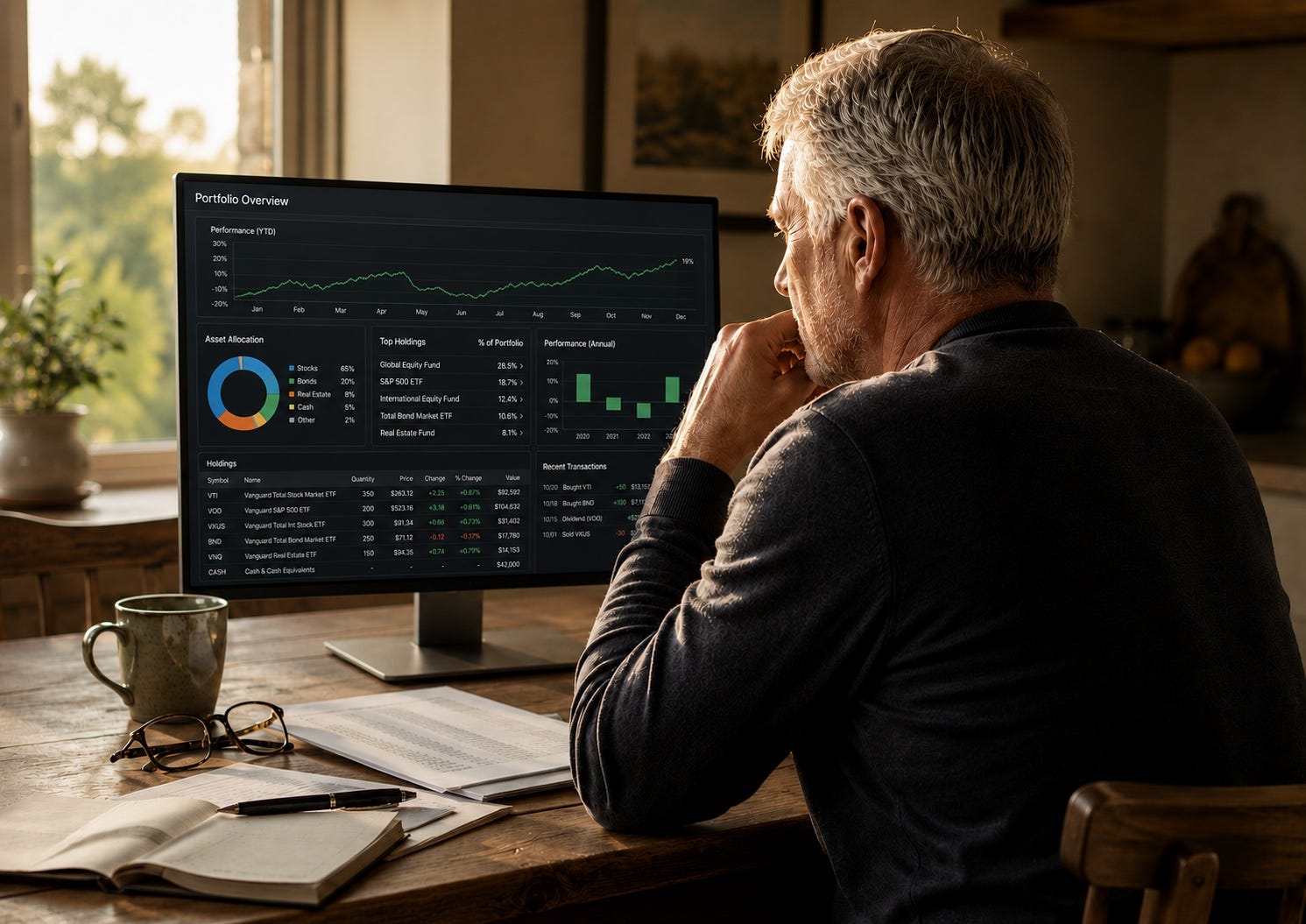
I‘ve started noticing something at this stage of life.
Some men have more money than they will ever be able to spend.
Some men have built real wealth, but time is starting to run out to enjoy it.
Some men are just entering retirement with a number that might work, as long as nothing too big goes wrong.
And almost everyone is trying to figure out the same thing.
How much is enough? How much can I spend? How much do I need to protect? And what happens if I get it wrong?
And underneath all of it is the one question nobody can answer.
How much time do I have?
None of us really knows when our show is going to be wrapped.
That is what makes spending so hard. It is always shadowed by time.
We spend our whole working lives saving for retirement. Then retirement finally shows up, and a strange thing happens.
We freeze.
The money is there, but spending it feels irresponsible. The trip feels too expensive. The upgrade feels unnecessary. The gift to the kids feels premature. The nice dinner feels indulgent.
So we wait.
Then a decade goes by. Maybe more. We kept saving. We stayed careful. We protected the number.
And now we are older than we thought we would be when we finally gave ourselves permission to enjoy it.
Not everybody plans for this part.
We plan for the accumulating. We plan for the mortgage. We plan for the RRSP. We plan for the company, the pension, the investments, the tax bill, the inheritance, the emergency that may never come.
The rule was simple. Don’t get fancy. Don’t get stupid.
But nobody really talks about how to stop accumulating and start planning for decumulation. Nobody really talks about how to shift from building the pile to using the pile.
The instinct that got you here, save first and spend later, does not know how to turn itself off. It just keeps running. Even after it has done its job.
And for men who spent decades measuring safety by how much was left over, that shift can feel almost reckless.
I know that feeling.
In my working life, I was trained to manage massive budgets. I was paid to know where the money went, and to make sure it was spent where it mattered.
That discipline followed me into retirement. It helped.
But retirement asks for something different.
Not just protecting the money. Knowing when to use it.
Here is what still surprises me.
At my Monday morning coffee group, men will talk about a colonoscopy without blinking. A knee replacement. A PSA number. A sleep apnea test. No hesitation at all.
Ask how they are doing financially, and the table gets quiet. Or someone says, “My guy is doing a great job.”
We will show each other our scars. We will not show each other our portfolio.
I understand the privacy. I feel it too.
I think money, for men of my generation, got tangled up with worth. Health is a shared enemy. Nobody thinks less of you because your knee gave out. But money feels different.
Money feels like a scoreboard nobody wants to admit he still checks.
And at this point in the game, some men are ahead, some men are behind, and some men are not even sure what the score means anymore.
That is a hard thing to admit out loud. Maybe the hardest thing.
Because money is rarely just money. It is pride. It is fear. It is control. It is shame. It is the story we tell ourselves about whether we did enough.
The real conversation is not about diversification, rebalancing, or fees.
It is underneath all of that.
Most of us do not need another reminder to be careful. We already know how to be careful.
We need a more honest question.
What is the money for?
Not in theory. In real life.
Is it for travel while your knees still work? Is it for the grandkids, while they still think spending time with you is exciting? Or is it for freedom, not fear?
Those are different answers.
And if we never ask the question, the default answer becomes simple. Keep it. Protect it. Do not touch it. Let someone else deal with it later.
I do not think about money as the goal anymore. I think about it as a means to choices.
And like any seasoned line producer, I cannot manage what I do not measure. I have always tracked where the money actually goes, not where I assumed it went.
Guessing is not a plan. It is hoping in disguise.
I have also learned to ask for help with the part I was never trained for. Not making the money. Using it well. That is a different skill.
Decumulation is not the same instinct as accumulation. Pretending it is can cost men years they do not get back.
The danger is not only running out of money. The danger is running out of health, time, energy, and appetite while still acting like the only goal is to preserve the account balance.
That is not prudence.
At some point, it is fear wearing a responsible jacket.
I do not know if men will ever talk about money as easily as we talk about our prostate.
Maybe we will not. Maybe the old wiring is too deep.
But I do know this.
The men who seem further ahead are not always the ones with the biggest number. They are the ones who have figured out what their number is for.
They know when to protect it. They know when to use it. They know the difference between being careful and being frozen.
And they understand something that is becoming clearer to me every year.
Somebody is going to enjoy those dollars.
I would rather it be me, with Sheryl, with my family, and with the people I care about, while I am still here to see it.
That feels like a better scoreboard.
Jim O’Grady writes The Post Game, a newsletter about life in the GoGo years. He lives in White Rock, BC.