

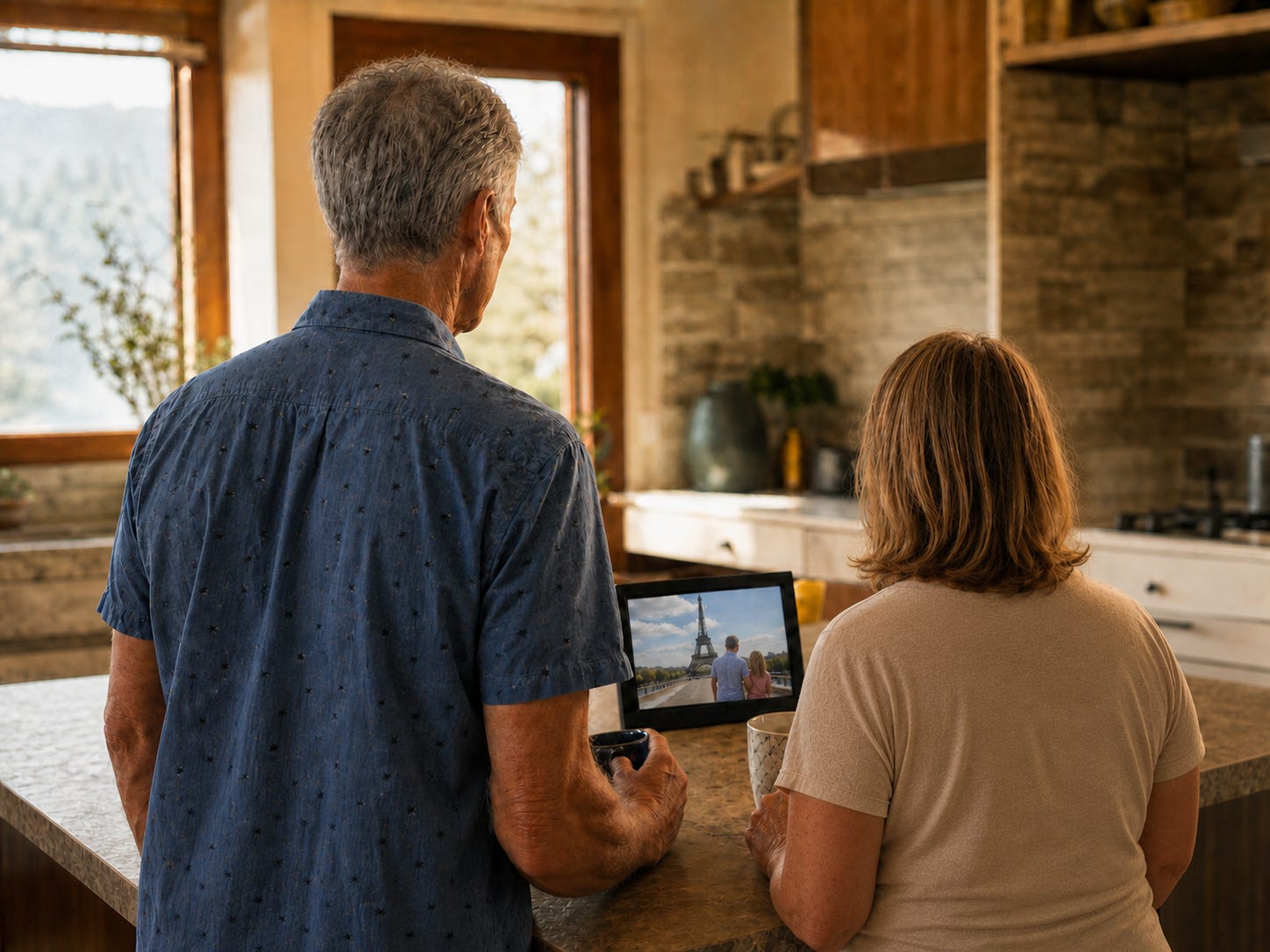
The other morning, a photograph on the digital display in our kitchen made me ask that question again.
It showed Sheryl and me standing in front of the Eiffel Tower in Paris. It was the day I turned 50.
I remember that day clearly.
It just did not feel as though it had happened more than a decade ago.
Where did those years go?
Plenty had happened: the arrival of two grandchildren, a move, the end of my career, losses and other significant changes.
I think back to summers when I was a teenager. They seemed enormous. The school year would end, and the weeks ahead felt almost limitless.
A summer in my sixties feels very different. June becomes July, July becomes August and soon I am wondering how fall arrived so quickly.
That photograph from Paris gave me the same feeling. The day seemed close enough to touch, but the date told me otherwise.
Sheryl and I have built a good life on the West Coast. Our family lives close by, and I get to spend time with our grandchildren. My body allows me to travel, train and ride my bike. I have a couple of great lifelong friends, and the men’s group has given me connection, purpose and reasons to leave the house several days a week.
There have been bumps and difficult stretches, but this is a good period in my life.
I do not take any of it for granted.
That may be why I notice time moving so quickly. When life feels this full, I want to experience it while it is happening, not just remember it afterwards.
Retirement did not give me more hours. I still get the same 24 I always did. It did, however, give me more choice over how I use them.
It took time for that freedom to feel like freedom. As I have written before, retirement did not arrive as a gift. There was a period when those 24 hours felt endless.
For most of my adult life, work determined much of my calendar. There were productions to manage, deadlines to meet and places I had to be. The days did not always belong to me, but they rarely lacked definition.
Without work separating one week from another, time can blur. Monday becomes Friday. Friday coffee arrives again. A month passes without anything clearly distinguishing it from the month before.
I wrote before that good days need a little shape.
Now I am realizing that if I want the years to feel different from one another, I have to give them some shape too.
A trip with Sheryl becomes something we anticipate, experience and remember. A bike ride with the guys gives an ordinary week a point of reference. An afternoon with our grandchildren often produces a moment we talk about months later.
They become markers, but not of accomplishment. I collected enough of those during my working life.
They tell me who I was with, what we shared and what made one part of the year different from another.
The point is not to fill every opening on the calendar. I spent enough years moving from one obligation to the next. I do not want to recreate that life in retirement and call it freedom.
The point is to stop assuming that the things that matter will somehow find their own place.
I still postpone things. I have already pushed a safari to “next year” twice.
At 61, I am not treating every plan as though it may be my last. I am simply noticing how easily next year becomes the year after that.
The next ten years may pass even more quickly than the last ten. But I am not entering them in the same way.
This time, I am paying attention.
I cannot make those years move more slowly.
What I can do is leave a trail.
A place. A person. A conversation. A story.
The photograph is not the marker. The experience is.
The photograph is the evidence it left behind.
The image of Sheryl and me in Paris remained on the display for only a few seconds before another photograph replaced it. But for those few seconds, we were both back there.
Ten years from now, another photograph may appear on our kitchen island.
When it does, I hope Sheryl and I stop again, not just to look at the photograph, but to remember the life we were living when it was taken.
Jim O’Grady writes The Post Game, a newsletter about life in the GoGo years. He lives in White Rock, BC.
Jim, this really stayed with me.
I especially loved the idea that if we want the years to feel different from one another, we have to give them shape.
Not necessarily through accomplishments. Not by packing the calendar. But through people, places, conversations, trips, ordinary afternoons, and moments that become landmarks in memory.
That distinction matters.
For so much of life, we are taught to measure time by what we achieve. Promotions. Deadlines. Projects completed. Things crossed off a list.
But later, perhaps the better question is: who was I with?
What did we share?
What happened that made this year feel different from the previous one?
And I think your line about leaving a trail may be the heart of the piece for me:
“A place. A person. A conversation. A story.”
That feels like a beautiful way to think about time.
We cannot make it slow down.
But we can make it leave footprints. ❤️
And perhaps that is what the photograph really gives us—not proof that time passed, but proof that we were fully somewhere while it was passing.
Jay, thank you for such a thoughtful response. This is so true "But we can make it leave footprints. ❤️"